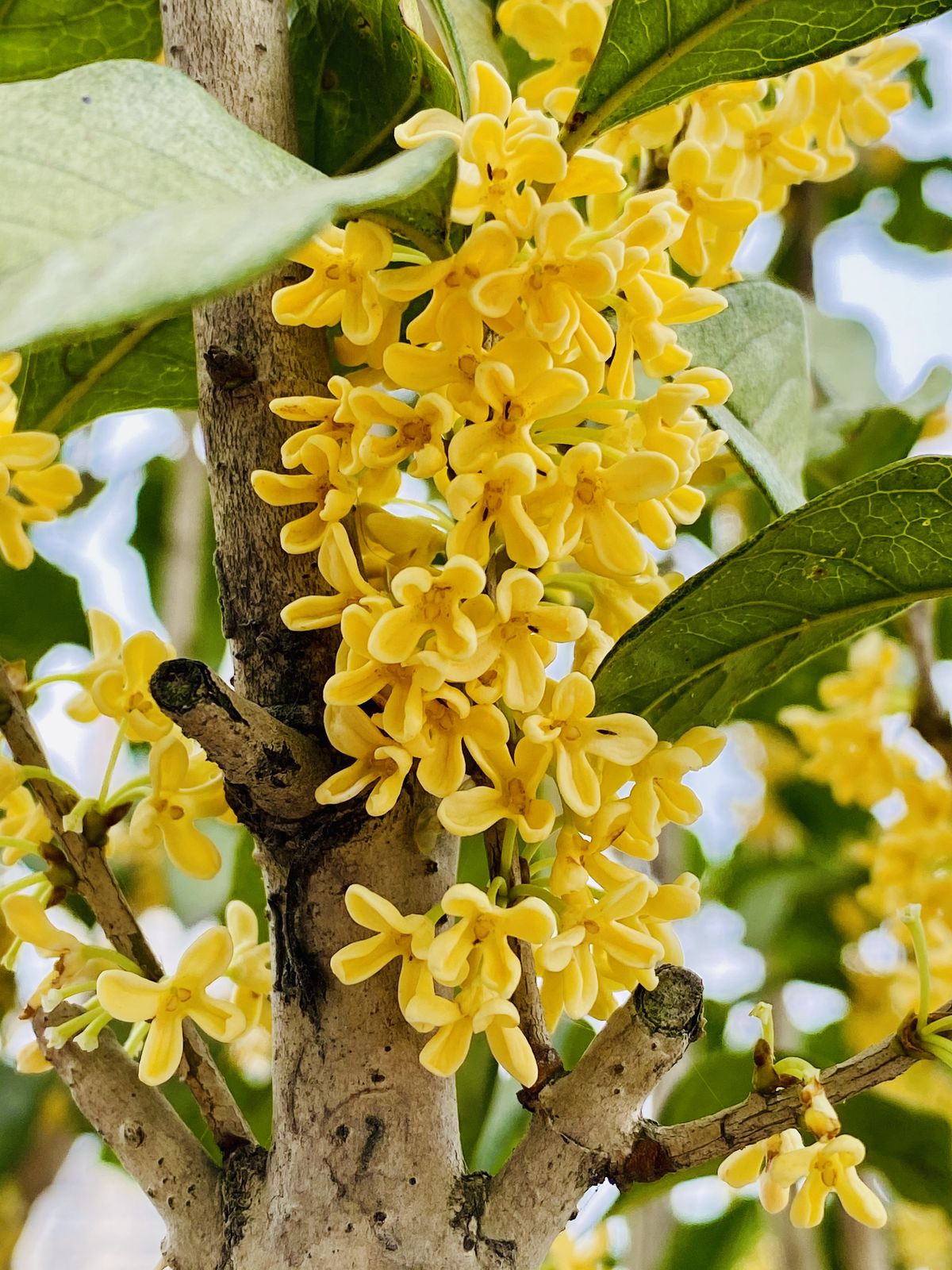


OSMANTHUS ABSOLUTE
Manufacturer: FLORAL CONCEPT
Botanical name: Osmanthus fragrans
Plant part: Flower
Country of origin: China
Country of manufacturing: Grasse, France
Extraction method: Solvent extraction
DESCRIPTION
Osmanthus Absolute is one of the most fascinating natural raw materials in contemporary perfumery, obtained from the small and intensely fragrant flowers of Osmanthus fragrans, cultivated in China and produced by Floral Concept in Grasse, at the heart of the French tradition of natural raw material processing.
Its profile is particularly distinctive because it combines three seemingly very different dimensions in a single raw material: a rich and ripe fruitiness, a delicate floral component, and a characteristic leathery and subtly animalic facet. Osmanthus Absolute is renowned for its apricot and yellow-fleshed fruit notes, accompanied by nuances of peach, honey, and white flowers.
This particular combination makes Osmanthus extremely interesting to the perfumer: it does not simply behave like a flower, but simultaneously introduces fruit, softness, warmth, and depth. Its fruity component is more sophisticated and less “edible” than that achieved through many synthetic fruity molecules, while the leathery facet adds a sensual and textural dimension.
Its Chinese origin is particularly significant for this raw material. Osmanthus fragrans is traditionally cultivated in several areas of southern China, with the flowers harvested during the autumn season. The botanical material is then subjected to extraction to obtain the concrete, which is subsequently purified to produce the absolute.
PERFUMERY
Osmanthus Absolute is particularly suited to the construction of floral, fruity, leathery, and oriental accords, although its use can extend to numerous olfactory architectures.
In floral accords, it introduces a sophisticated and sensual fruity dimension. It can be used with rose, jasmine, tuberose, gardenia, magnolia, ylang-ylang, and orange blossom, creating softer, more voluptuous, and contemporary bouquets.
Its natural affinity with apricot and peach makes it particularly valuable for constructing yellow-fleshed fruit accords. It can be combined with gamma-decalactone, fruity aldehydes, ionones, vanilla, and other fruity materials to create peach, apricot, compote, and ripe fruit accords with greater natural depth.
One of its most interesting applications is in leathery accords. The leathery facet of Osmanthus makes it possible to create a softer, more floral, and sensual leather than constructions based exclusively on phenolic or strongly smoky materials. It can be used with Birch Tar, Safranal, Suederal, castoreum-style materials, labdanum, styrax, patchouli, and dark woods.
It is also highly interesting in tobacco accords, where its apricot-like and subtly leathery character creates a natural bridge between the fruity, ambery, and dry facets of tobacco.
In oriental and ambery compositions, it helps make the base softer and more sensual, particularly when combined with vanilla, benzoin, labdanum, tonka, and musks.
Its distinctive fruity facet also makes it useful for adding complexity to gourmand accords, especially when an excessively sweet or edible result is to be avoided. Osmanthus introduces a natural fruitiness accompanied by floral and leathery facets that keep the accord sophisticated.
From a formulation perspective, it can be used both as a characterising material, when a specific olfactory theme is to be built around Osmanthus, and in smaller quantities as a modifier to add volume, sensuality, naturalness, and depth.
Also available at 10% in Natural TEC for easier dosing and improved diffusion.
Olfactory family: Floral
Olfactory pyramid: Heart-base note